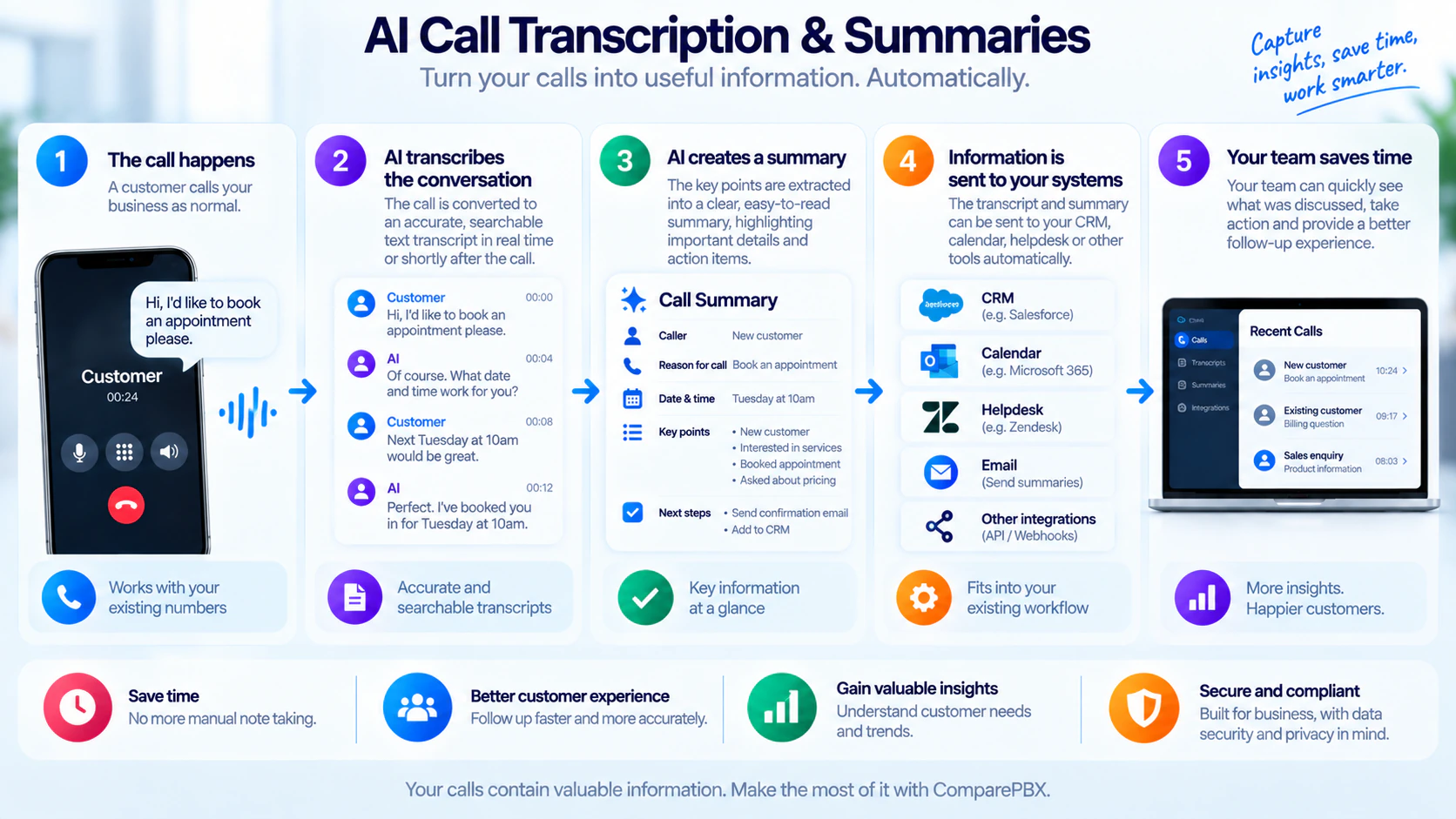
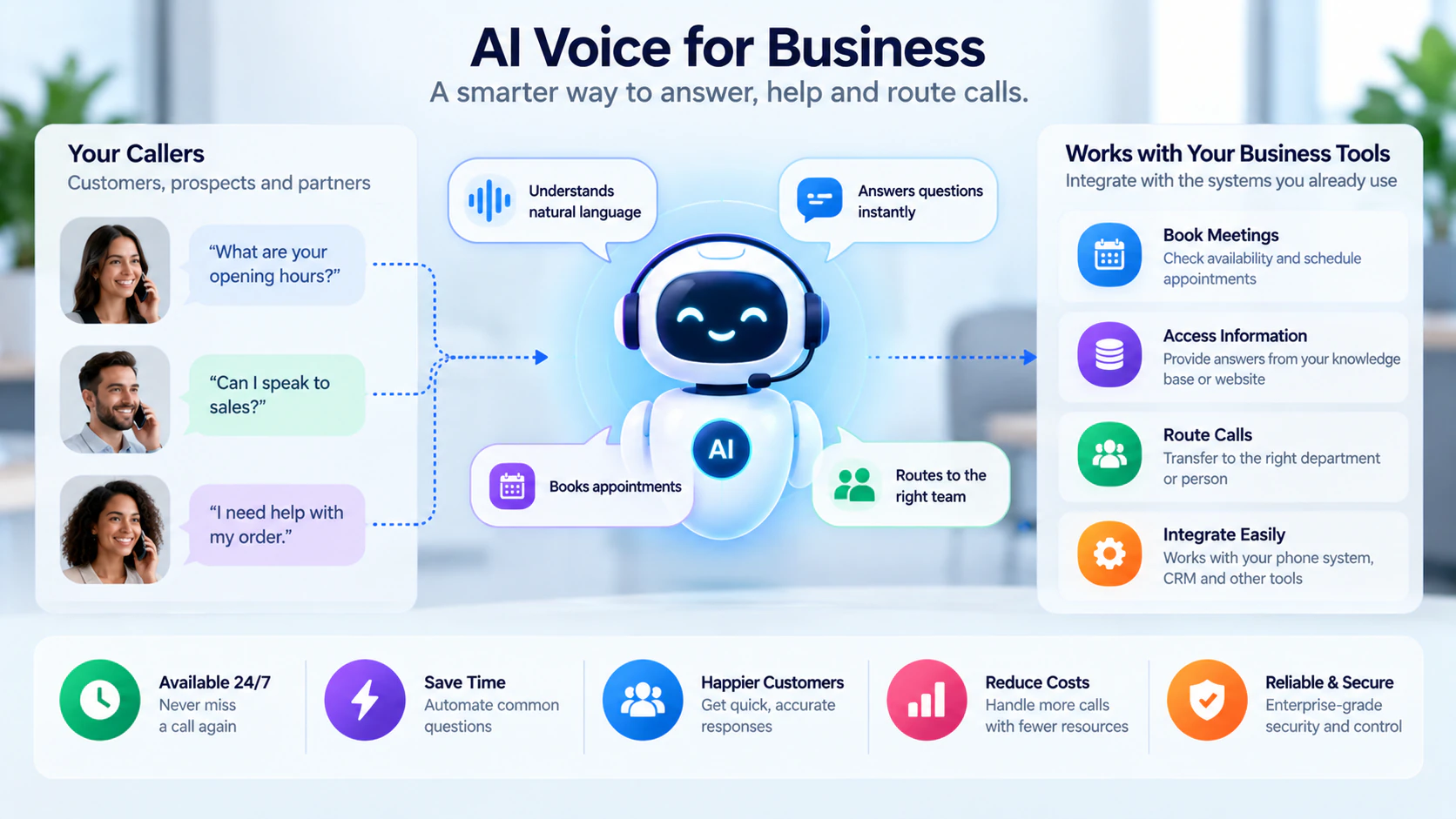
IN SIMPLE TERMS
AI voice tools can help with conversational interactions or processing spoken information.
FROM THE IDEA TO YOUR WORKING DAY
What this means
for your business
A service desk could evaluate a narrow enquiry flow before considering broader automation.
SEE HOW IT CONNECTS
How an AI Receptionist Works
Give callers a useful first response and a clear next step.
Explore this guide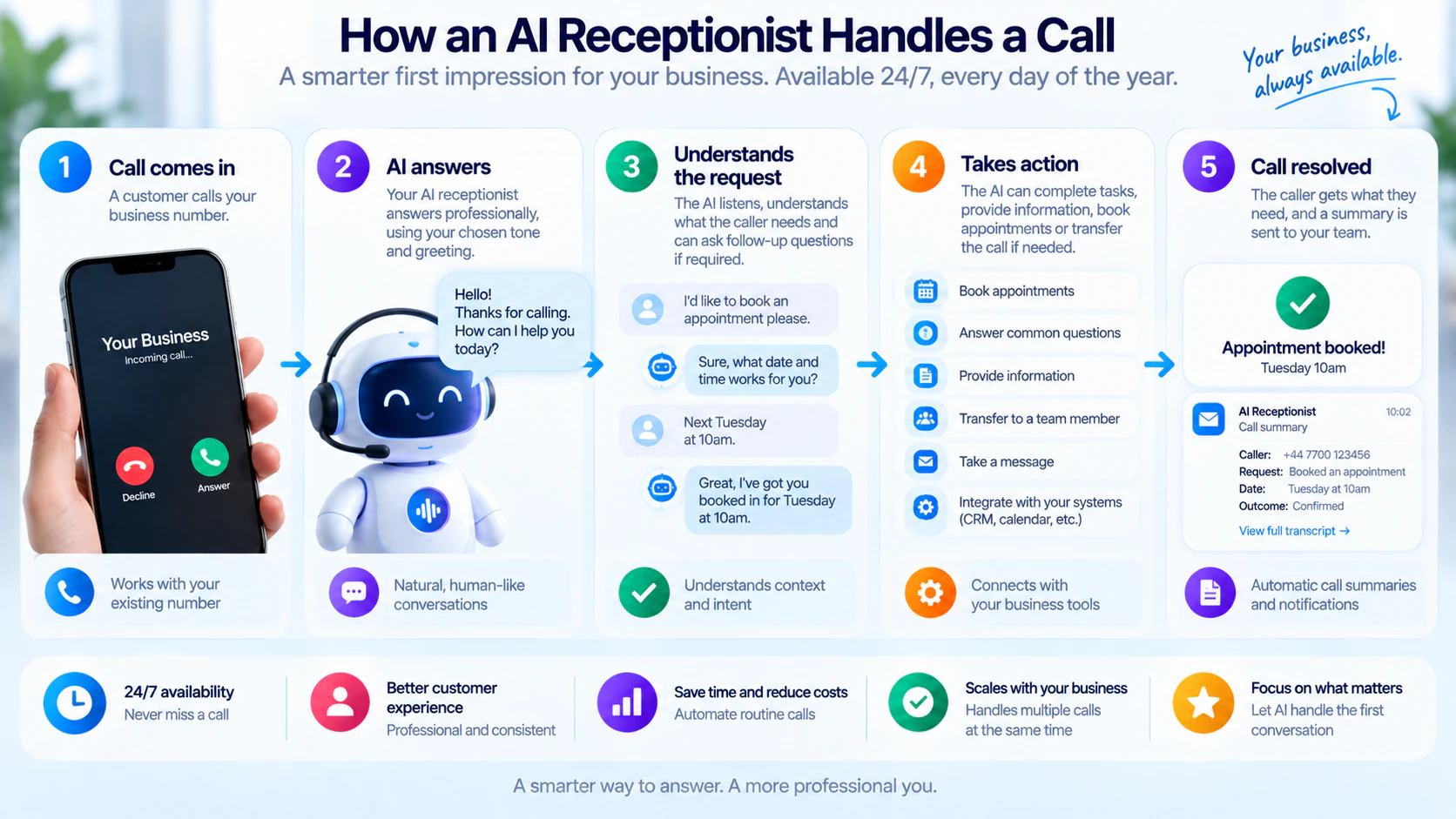
THE QUESTIONS THAT MATTER
Key
considerations
Define a route to a person.
Test realistic and unexpected requests.
Review data handling and output quality.
GO A LITTLE DEEPERTechnical deep dive
AI voice combines telephone control with speech processing and a managed conversation. It can help with defined tasks, but the ability to produce natural speech is not proof that an answer or action is correct.
Call control surrounds the AI
A telephony layer answers, transfers and ends calls. It connects the caller’s media to the automation and should preserve a route to a person. Traditional IVR normally follows configured menus and rules; AI automation can interpret more open-ended speech. It still needs an explicit scope and predictable fallback paths.
Listening, interpreting and speaking
Automatic Speech Recognition (ASR) converts speech to text in many designs. Natural-language processing or a language model interprets a request, and text-to-speech (TTS) turns a response into audio. Some systems process speech more directly. Accents, background noise and specialised names can introduce errors, so important details should be confirmed.
The orchestration layer decides what may happen
Dialogue orchestration tracks the conversation and chooses permitted steps. APIs can retrieve opening hours, check a booking or update a record. The surrounding application must validate arguments, authenticate sensitive requests and control permissions. A model proposing an action is not authorisation to perform it.
Timing changes the experience
Network travel, speech recognition, reasoning, external lookups and speech generation all contribute to latency. Long pauses make callers repeat themselves. Turn-taking decides when someone has finished; interruption handling should stop playback and listen when the caller speaks. Test hesitations, overlapping speech and noisy lines, not only scripted demonstrations.
Escalation must actually reach a human
Offer a clear human route for uncertain answers, repeated failures or requests outside scope. A handoff should include useful context without inventing facts, and handle unavailable staff with an agreed alternative. Transcription produces a text record; summaries compress it and may omit or misstate details. Review consequential records before using them to make decisions.
Data handling and monitoring are part of the design
Map where audio, transcripts and summaries go, who can access them and how long each service retains them. Monitor transfer success, failed actions and unresolved requests, not only call volume. Use representative evaluation calls, constrained actions, human review and a fallback when an AI or integration service is unavailable. Safeguards should be tested after configuration or model changes.
Manufacturer & platform documentation
Optional further reading from the organisations behind the technology, including standards bodies. Platform examples describe that platform’s implementation.