Contact Centre
What is a Contact Centre?
Organise how customers reach your team and how work reaches the right person.
Start with the essentials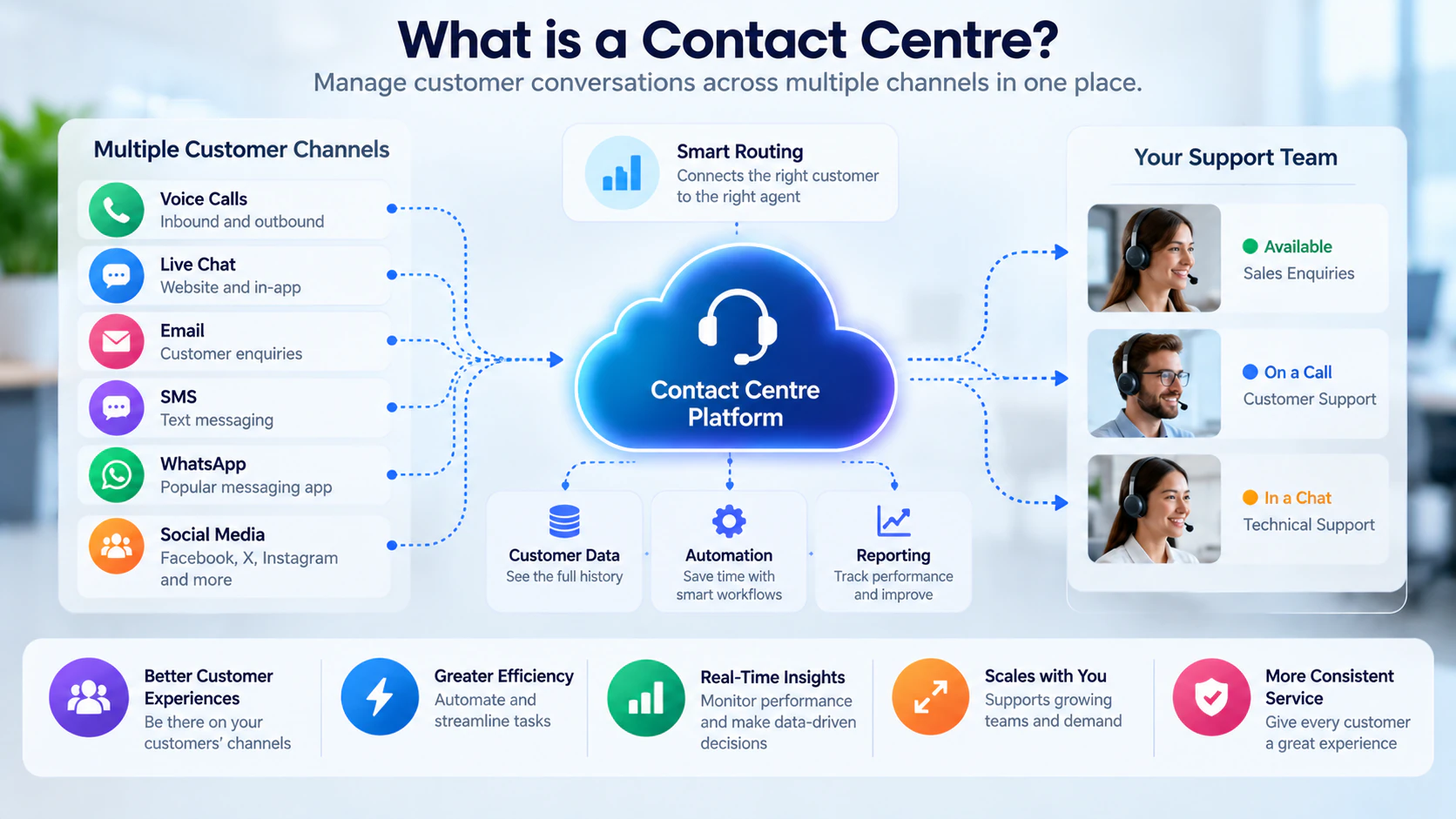
IN SIMPLE TERMS
A contact centre combines people, processes and communication tools to handle customer enquiries.
FROM THE IDEA TO YOUR WORKING DAY
What this means
for your business
A service team could route incoming enquiries to specialists and review how long customers wait.
SEE HOW IT CONNECTS
Call Centre vs Contact Centre
The difference starts with the conversations you support.
Explore this guide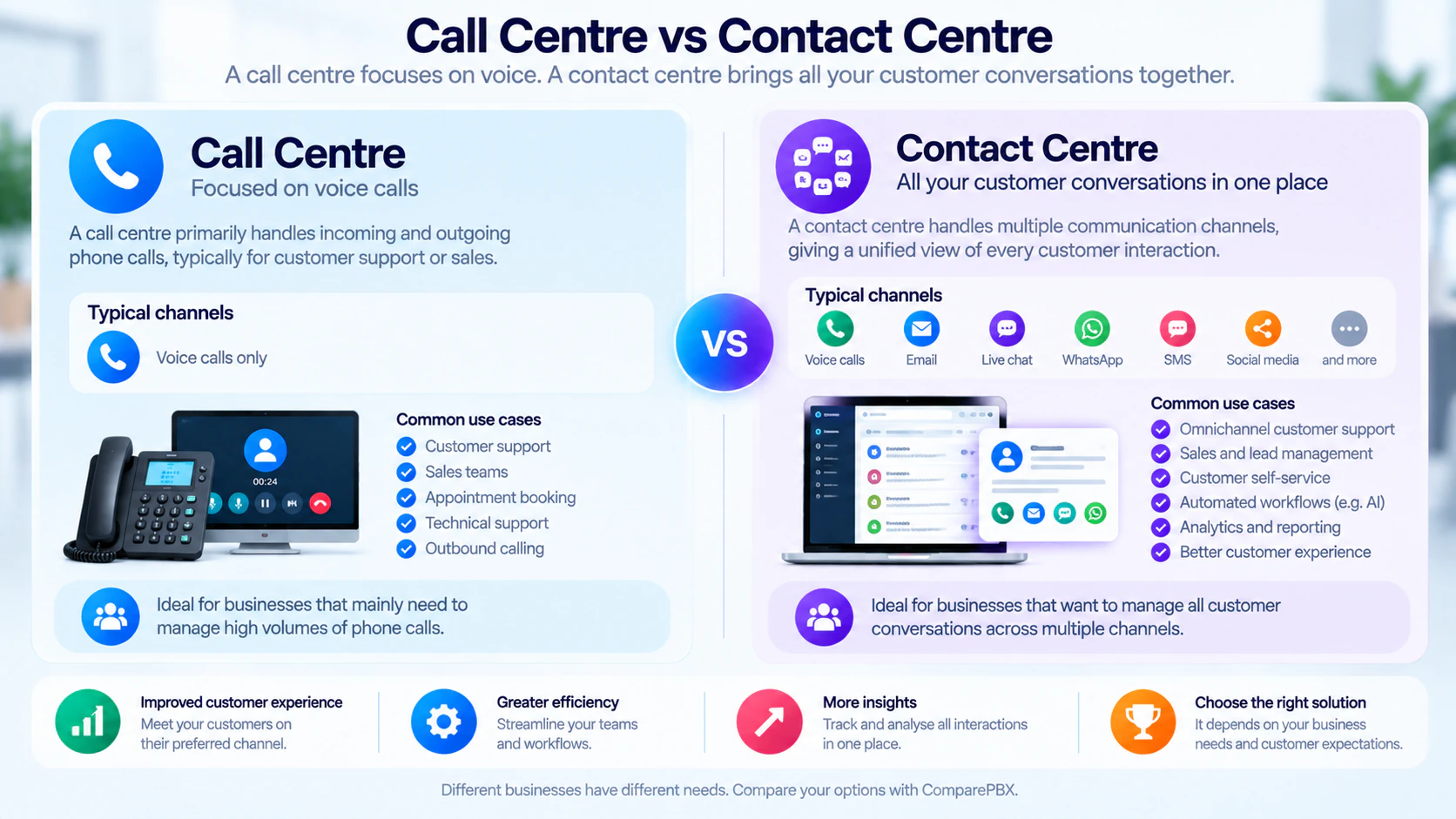
THE QUESTIONS THAT MATTER
Key
considerations
Map the channels customers use.
Agree queue and handover rules.
Choose reporting that supports the team’s work.
GO A LITTLE DEEPERTechnical deep dive
A contact centre coordinates customer work, not just telephone extensions. Routing, agent availability and customer context must work together so each interaction reaches someone who can resolve it.
ACD, IVR and queues
Automatic Call Distribution (ACD) selects which available agent should receive a call. An IVR gathers a caller’s choice or information before routing; queues hold work waiting to be assigned. Skills-based routing can consider language, expertise or priority. Define overflow and maximum-wait behavior so an unanswered queue has a clear next step.
Agent states are operational signals
Available, busy, away and after-call work tell the routing system whether an agent can accept another interaction. Incorrect state settings can create apparent understaffing or interrupt people while they complete records. Supervisors need visibility into states alongside actual workload, rather than judging performance from call totals alone.
Recording and reporting serve different purposes
Recording retains conversation content; reporting describes events such as waits, transfers and abandoned calls. Analytics may add derived information, which still needs context. Establish who can access recordings, the applicable notice/consent requirements and retention settings. Agree definitions for metrics before comparing teams or platforms.
CRM integration needs reliable identity
A CRM connection can surface customer records, attach call activity or trigger follow-up. APIs exchange data and events, but matching a telephone number to a record does not prove a caller’s identity. Plan authentication for sensitive actions, restricted integration permissions and what agents see if the CRM connection fails.
Omnichannel means continuity across channels
Phone, email, chat and messaging may feed a shared routing and customer-history layer. That can help a person continue a conversation without repeating everything, provided identity, permissions and channel history are joined correctly. Several separate inboxes on one screen are not necessarily a coherent omnichannel workflow.
Cloud services still depend on local operations
A cloud platform may separate telephony, routing, recording, reporting and integration services. Workforce management integrations can use demand and staffing data for planning; quality-management tools can support review and coaching. Agents still depend on headsets, computers and stable networks. Test degraded-service behavior and clarify which supplier handles each incident.
Manufacturer & platform documentation
Optional further reading from the organisations behind the technology, including standards bodies. Platform examples describe that platform’s implementation.