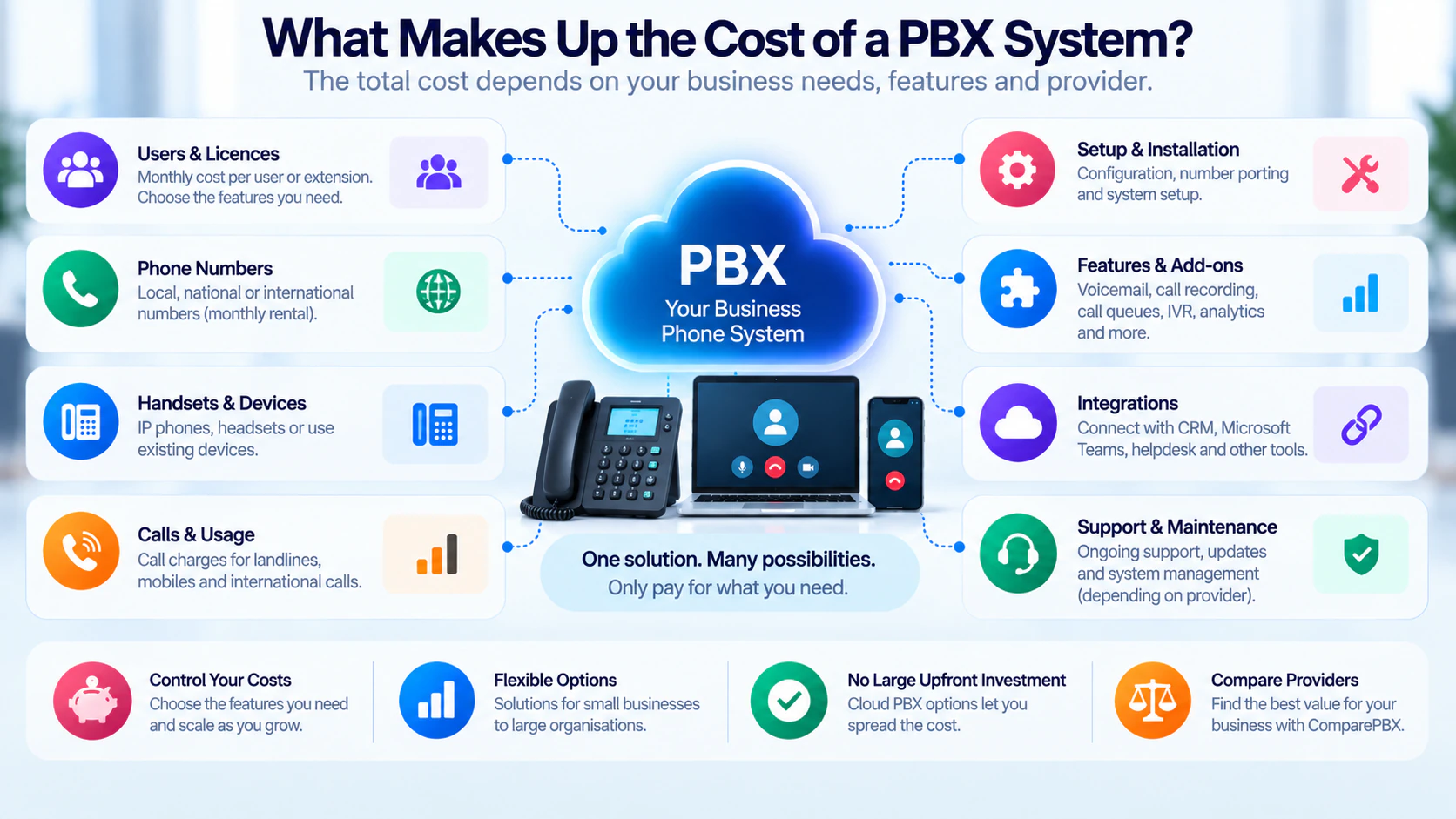
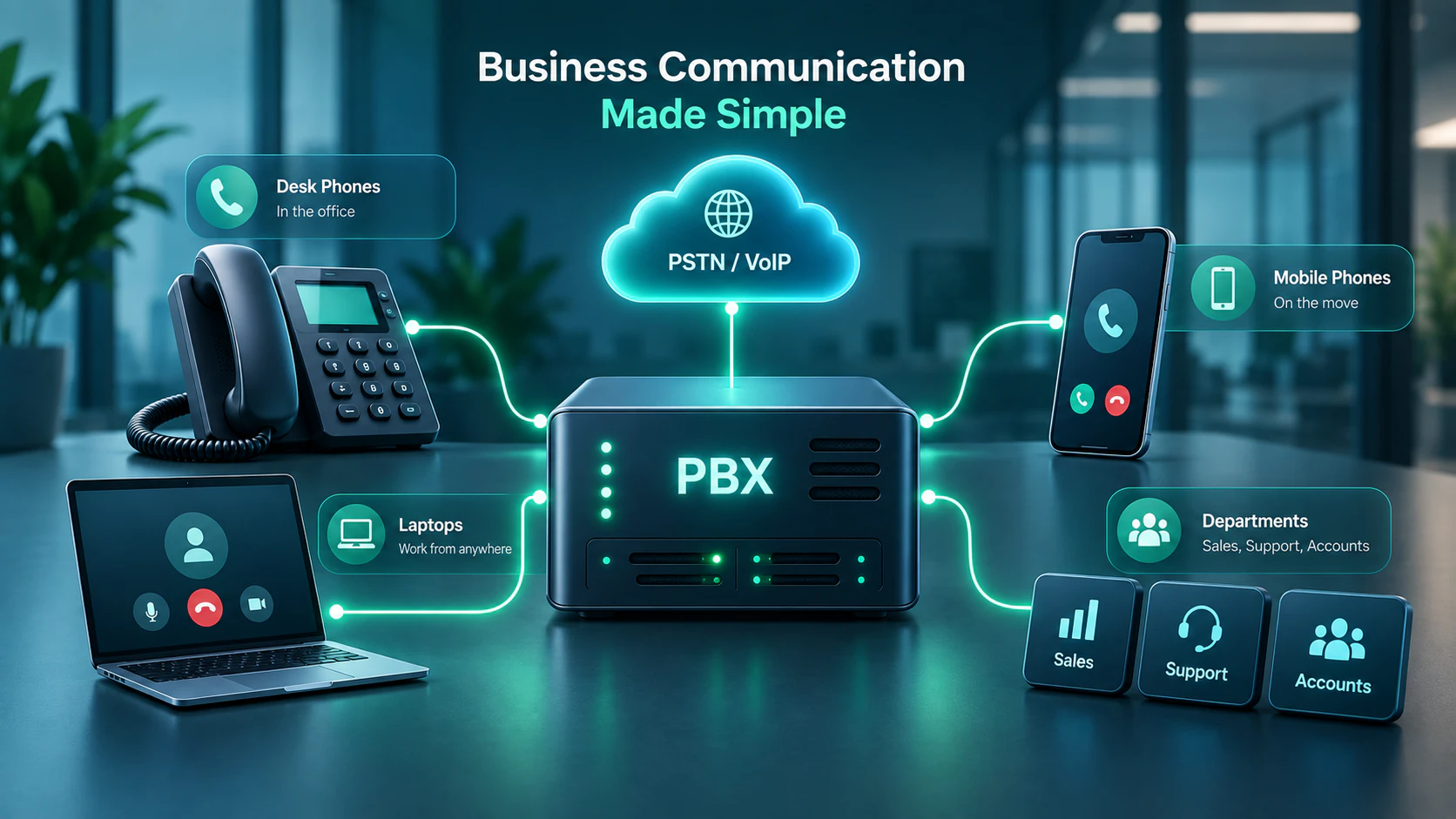
IN SIMPLE TERMS
It connects extensions and directs incoming calls to people, groups or voicemail.
FROM THE IDEA TO YOUR WORKING DAY
What this means
for your business
A reception team could route callers to sales during opening hours and voicemail after closing.
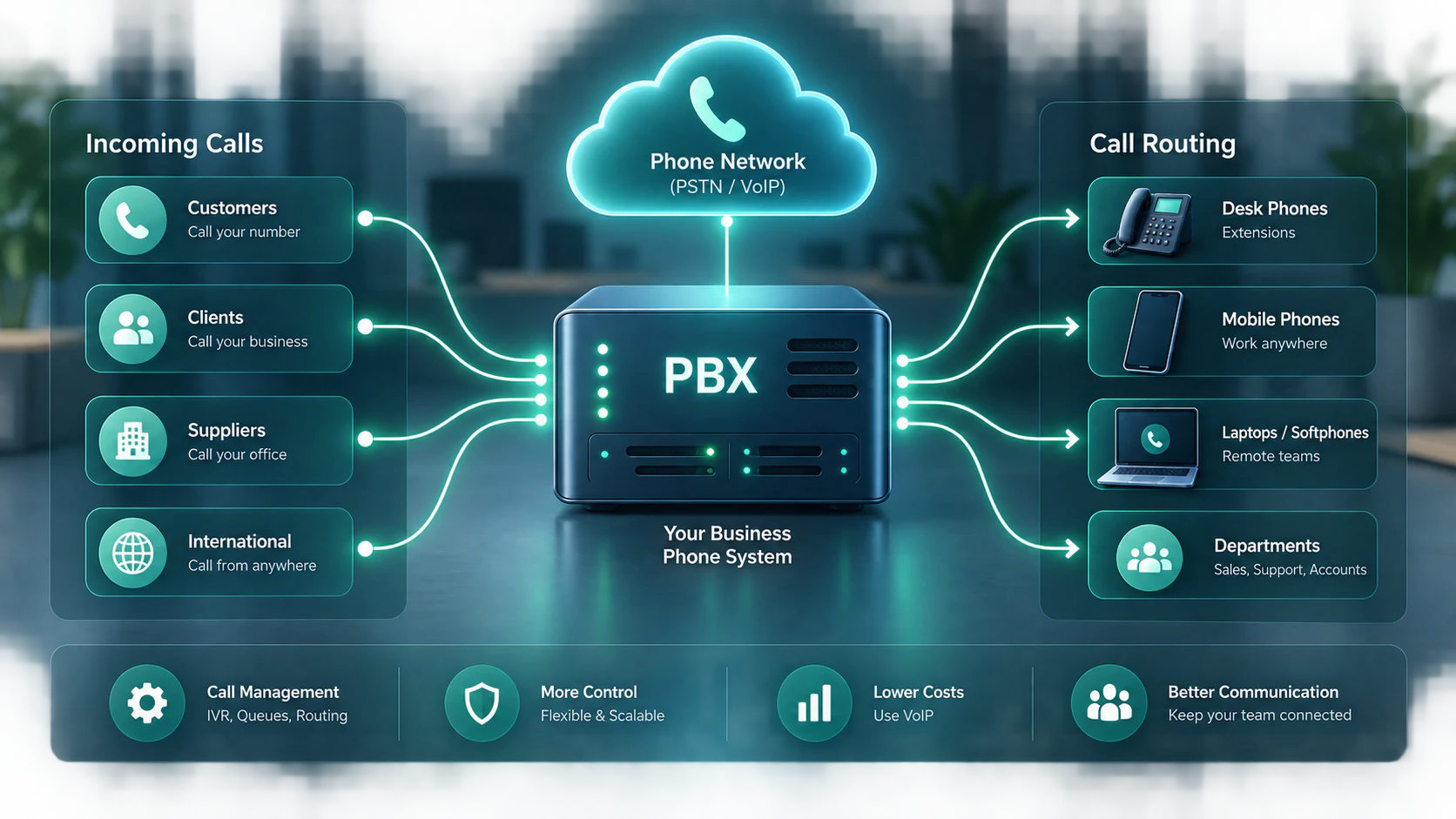
SEE HOW IT CONNECTS
How a call finds the right person.
THE QUESTIONS THAT MATTER
Key
considerations
Map opening hours and destinations.
Decide who will maintain the system.
Ask about resilience and support.
GO A LITTLE DEEPERTechnical deep dive
A PBX is the call-control layer for an organisation. It connects people and applies rules about where calls should go. Understanding its separate building blocks makes a proposed system easier to evaluate than a long list of feature names.
Extensions connect people to endpoints
An extension is an internal identity or short dialling destination. A person may use a desk phone and an app with the same extension, depending on the platform. Endpoints commonly use SIP registration to tell the PBX where they can be reached. Internal calls may stay within the system; external calls need a route to another network.
Trunks and public numbers do different jobs
A trunk connects the PBX to a voice provider or another system. A DID (Direct Inward Dialling), also called a DDI, is a public number that can be routed to a person or service. Ten numbers do not necessarily provide ten simultaneous calls: numbering, trunk capacity and user licences are separate design questions.
Dial plans turn numbers into destinations
Inbound routing can send a called number to reception during office hours and voicemail afterwards. Outbound routing chooses which trunk to use and what number format to send. A dial plan describes the patterns, permissions and transformations behind these decisions. Document allowed destinations and emergency-call arrangements before changing those rules.
Groups, queues and menus shape the caller experience
Hunt groups or ring groups distribute ringing among a set of people, either together or in a sequence. A queue holds callers while waiting for an available agent and may offer announcements or a callback. An IVR or auto attendant presents choices and routes responses. These tools need clear timeout, overflow and out-of-hours destinations; otherwise a polished greeting can still lead to a dead end.
Voicemail needs ownership
Voicemail stores a message when a call is unanswered or routed to a mailbox. Decide whether a mailbox belongs to an individual or a team, who receives notifications and how messages are reviewed. Storage limits and retention settings affect whether missed calls become useful follow-up work.
Hosting changes responsibility
A cloud PBX runs in infrastructure outside the office; an on-premises PBX runs on local equipment. In both cases someone must own configuration, backups, updates and incident response. Provisioning supplies phones with settings such as their account, server and function keys. Supported provisioning can reduce manual errors when adding or replacing devices.
Failover is a whole-call-path question
A second PBX or internet link does not, by itself, guarantee that callers can still reach you. Number routing, carrier availability, DNS, local power and endpoints all affect continuity. Agree what should happen during an outage, how quickly it should happen and how it will be tested. Some failover designs restore new calls but cannot preserve conversations already in progress.
Manufacturer & platform documentation
Optional further reading from the organisations behind the technology, including standards bodies. Platform examples describe that platform’s implementation.